
Emu
(Dromaius novaehollandiae)
The Emu is the largest bird in Australia, and the second tallest bird in the world, reaching up to 1.9 metres (or 6.2 feet) in height.
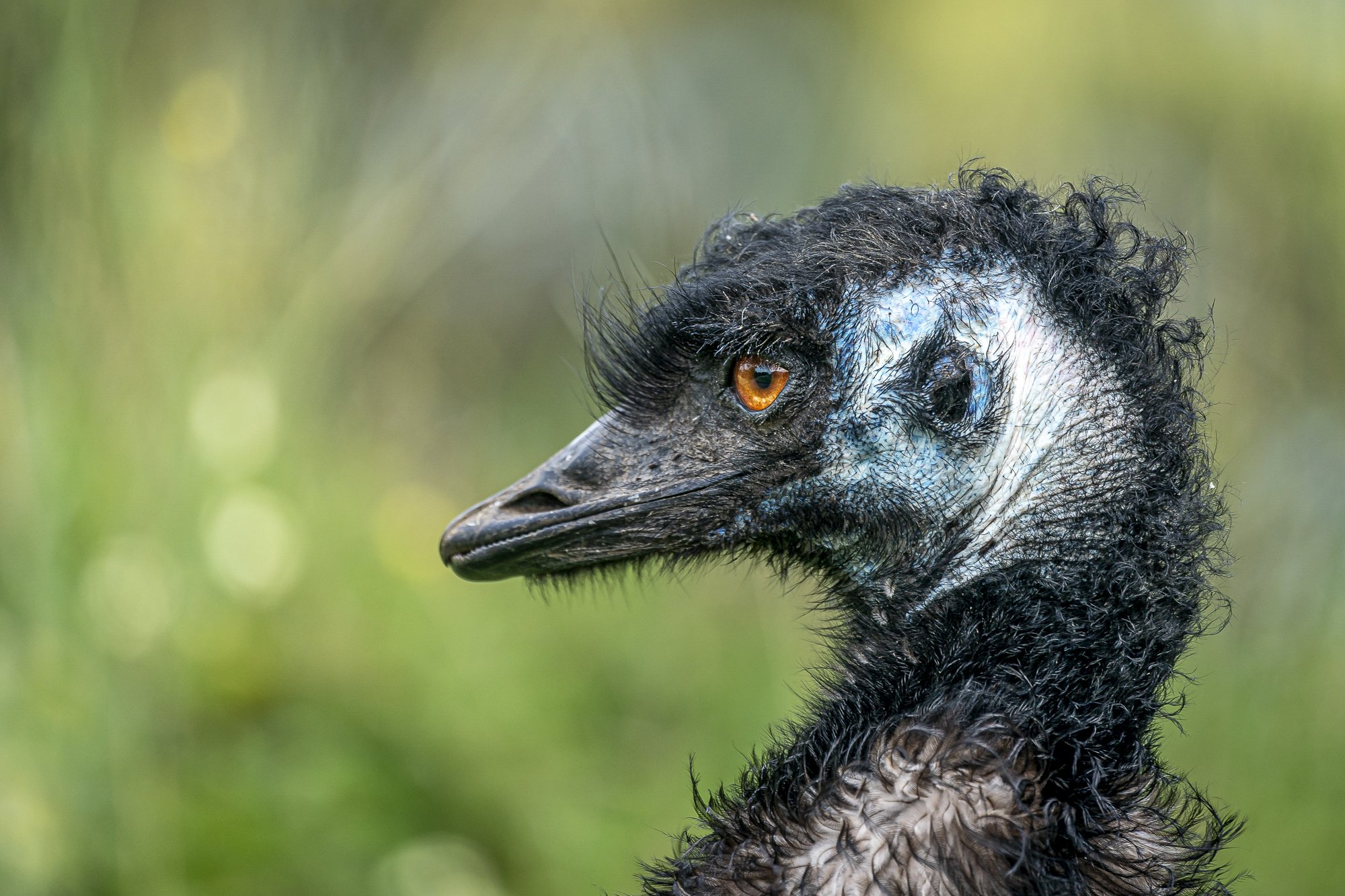


Emus cannot fly…but they can run and kick.
Emus are unique creatures; they have small black wings, with a small claw at the tip. Their long, strong, featherless legs end in large soft-cushioned, three-toed feet. The skin of their pale blue necks shows through their sparse feathers and the shaggy plumage around their mid-body is grey-brown.
Emus cannot fly, but they can travel great distances and can sprint at 50 km/hour (or 31 mph), taking huge strides – well over 2 metres (or 6.5ft). Sharp claws on their toes help them to defend themselves by kicking, while their excellent eyesight and hearing allow them to detect threats at some distance. Their eyes are protected from dust and wind by translucent, secondary eyelids that move from the inside edge of the eye to the outside edge.
They can go for weeks without eating.
These fascinating birds forage for a variety of insects and plants, but they can go for weeks without eating. They eat a wide variety of plants, grasses and insects, and contribute to floral biodiversity by dispersing larger seeds as they move around the bush. Small stones are swallowed to assist in the grinding up and digestion of the plant material. They drink infrequently, but consume vast amounts of water when they do.
Male emus build the nest, sit on the eggs and raise their young.
Their breeding habits are also interesting. The male builds a rough nest in semi-sheltered hollows on the ground and lines it with leaves, bark and grass. Breeding takes place in May and June, and it is common for females to fight for a mate – and to mate several times. After mating they can lay several clutches of eggs which are incubated by the male for around eight weeks, turning them around ten times each day. During this time, the male hardly eats or drinks, so he loses a lot of weight. Once the eggs hatch, it is still the father who cares for them, teaching them how to find food until they reach full size in around six months. They often remain as a family unit until the next breeding season.
The sound of the emu.
Vocalisations mostly consist of booming and grunting, with the females tending to boom as part of the courtship ritual or a threat to any rivals. The males tend to grunt in defence of their territory, as a threat to other males, and during courtship.
They are diurnal.
After spending the day searching for food, Emus settle down at sunset and slowly lower themselves to the ground to sleep during the night, their shaggy feathers providing great camouflage and protection from rain.
Aboriginal culture.
Some Aboriginal names for Emus in Victoria include ‘Barrimal’ in the Djadja wurrung language; ‘Myoure’ in Gunai and ‘Courn’ in Jardwadjali. The birds have a prominent place in Australian Aboriginal stories – the Yuwaalaraay group in New South Wales believe the sun was made by throwing an emu’s egg into the sky.
Emus at Wildlife Wonders.
The beautiful Emus living at Wildlife Wonders are safe from threats and can be admired as they stride freely through the forest and grassland areas. They can be curious too, often famously visiting the Emu Cafe window. The emus have successfully bred here at Wildlife Wonders in 2025 where we welcomed a healthy clutch of stripey baby emu chicks.
Like so many Australian native animals, Emus are threatened by land clearance and fragmentation that destroy their habitats; by predation of their eggs and young; and by collisions with vehicles.
Book your tour for a chance to see emus at Wildlife Wonders.